
Exploring Generative AI in Content Creation
Let’s be honest. Nobody budgets for “accidental cloud sprawl.” It’s not a line item anyone approves. And yet, here you are, staring at an AWS invoice that has quietly doubled in eighteen months, wondering which engineer spun up what, and when, and whether it’s safe to turn any of it off.
Welcome to the club. It has excellent Wi-Fi and terrible financial hygiene.
The good news? Cloud cost bloat is one of the most solvable problems a growing business faces. Not the most glamorous, nobody’s winning awards for right-sizing their EC2 instances , but solvable, sustainably, without touching product velocity or making your engineers feel like they’re coding on a budget airline.
This is the playbook we use at Marlocks Technologies to help businesses across Africa and beyond take back control of their cloud spend. We’ll give you the framework, the real-world patterns, and just enough of the strategy to make your next AWS budget conversation a very different one.
The companies that cut their cloud bill by 30–40% and keep it there aren’t doing anything exotic. They’ve built a practice around cost , not a one-time audit.
Part 1: Why Your AWS Bill Grows When You're Not Looking
Cloud environments don’t spiral because of bad intentions. They spiral because of absent ones.
Engineers provision quickly to meet deadlines. Resources stay up long after the project ends. Nobody deletes them because nobody’s sure who owns them. New services are added every quarter. Old ones are never retired. Pricing plans designed for fifty users are still in place at five thousand.
Real-World Pattern: The Fintech That Grew Too Fast
A Series B fintech scaling across three African markets found itself with an AWS bill that had tripled in two years. Usage had roughly doubled , so where was the extra third coming from?
A structured FinOps assessment revealed: 23% of compute spend was on idle or underutilised instances from deprecated product features. Development environments were running 24/7, including weekends. Three separate data pipelines were duplicating work because different engineering squads had built them independently , without knowing the others existed.
None of this was malicious. It was just invisible. Once they could see it, fixing it took six weeks.
By the time finance starts asking hard questions, the environment has become a maze. This isn’t a technology problem. It’s a governance problem. And governance is where every meaningful cost reduction begins.
Part 2: The FinOps Framework , Inform, Optimise, Operate
FinOps , Cloud Financial Operations , is the discipline of bringing financial accountability to cloud spend. The FinOps Foundation structures it in three continuous phases. Think of it less like a project and more like a metabolic process your organisation runs permanently.
Phase 1: Inform , You Can’t Manage What You Can’t See
This phase is about visibility and allocation. Which teams are spending what? Which products? Which environments? Most growing businesses cannot answer these questions within twenty minutes , which means they cannot act on them either.
The foundation here is tagging. Every resource tagged by owner, environment, product, and cost centre becomes a resource you can interrogate. Without it, your AWS bill is a black box with a very large number at the bottom.
Beyond tagging, modern FinOps practices deploy AI-powered cost agents that continuously monitor Cost Explorer data, surface anomalies in real time, and sync insights across engineering and finance , removing the lag between spending and knowing you’re spending.
Real-World Pattern: The Healthcare Platform Paying for Its Own Mystery
A healthcare technology company running on AWS had seventeen engineering squads and zero tagging policy. When finance asked which product line was responsible for a 40% spike in data transfer costs, the answer took three weeks to assemble , manually.
After implementing a tagging strategy enforced through AWS tag policies, the same question took eleven minutes to answer. The spike turned out to be a single data pipeline running nightly exports to the wrong S3 region , fixable in an afternoon, once visible.
Phase 2: Optimise , The Fast Wins Are Real
In our experience, a first-pass optimisation on a mid-sized AWS environment typically surfaces 20–35% of spend that can be reduced within 60 days , without architectural changes.
The highest-impact levers:
• Rightsize compute , Most EC2 instances and managed databases are over-provisioned for workloads that never hit peak. AWS Compute Optimizer gives data-driven recommendations that often reveal 20–40% compute savings alone.
• Kill idle resources , Unattached EBS volumes, unused Elastic IPs, orphaned snapshots, forgotten NAT gateways. They accumulate silently and bill daily.
• Schedule non-production environments , A dev environment running 10 hours a day on weekdays costs roughly 30% of one running continuously. Automate with AWS Instance Scheduler.
• Move cold data to cheaper tiers , S3 Intelligent-Tiering moves objects between access tiers automatically, often cutting storage costs by 40–70% on older data.
• Claim the discounts you’re entitled to , Savings Plans and Reserved Instances can cut compute costs by 30–72%. Most businesses qualify and never claim them.
Real-World Pattern: The E-Commerce Business Paying Full Price for Everything
A regional e-commerce platform with fairly predictable traffic patterns was running entirely on on-demand pricing , the most expensive way to use AWS. They had never explored Savings Plans because “nobody had gotten around to it.”
A Compute Savings Plan covering 60% of their baseline usage reduced their monthly compute bill by 34% overnight. Combined with rightsizing recommendations from Compute Optimizer, total compute savings in the first 90 days exceeded 47%. The work took one afternoon to implement.
Part 3: A Note on Africa-Specific Dynamics
For businesses operating across African markets, cloud cost management carries an additional dimension that often goes unacknowledged.
AWS bills are denominated in US dollars. Local currencies are not. Nigerian fintechs that were running comfortable AWS budgets in 2020 found themselves with invoices that had effectively tripled in naira terms by 2024 , not because usage tripled, but because the naira depreciated significantly.
A disciplined FinOps practice is one of the most effective currency hedges a business in a volatile-FX environment can build. Every dollar you don’t spend is a dollar that doesn’t need to be sourced at an unfavourable rate.
This gives cost optimisation a strategic weight in African markets that goes beyond the standard efficiency argument. It’s not just good practice , it’s risk management.
Part 4: What We Haven't Told You Yet
If you’ve made it this far, you’ve got the framework. You understand the phases, the levers, the patterns, and why this matters more in the markets most of our clients operate in.
But there’s a significant amount we’ve deliberately left out of this post.
Specifically:
• The sequencing decisions that determine whether your FinOps programme saves money in Month 1 or Month 9 , and why most companies get this wrong
• How to structure the internal conversation between engineering, finance, and leadership so that cost accountability doesn’t create friction that slows the business down
• The specific commitment strategy for Savings Plans and Reserved Instances , including the common mistake that locks companies into plans that don’t fit their actual usage curve
• How AI agents are changing what’s possible in real-time cost management , and what to look for when evaluating them for your environment
• The AWS funding programmes and partner benefits that our clients use to offset the cost of migration and modernisation , programmes most businesses don’t know exist
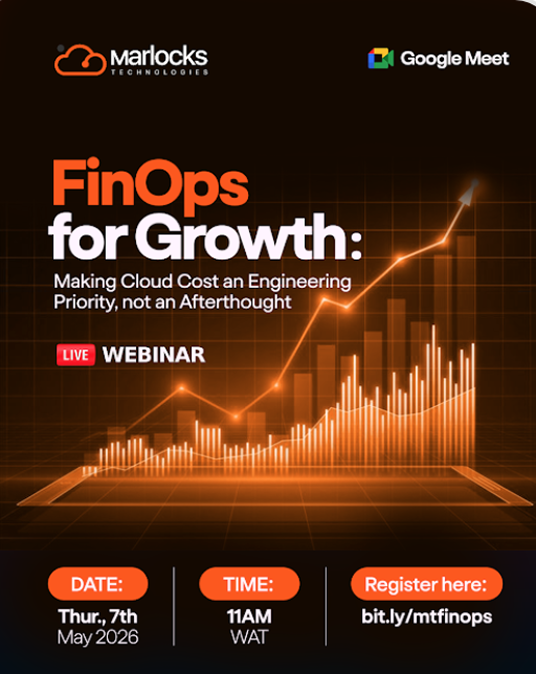
We cover all of this , in depth, with live examples , in our upcoming webinar.
About Marlocks Technologies
Marlocks Technologies is an AWS Advanced Consulting Partner helping enterprises and growing businesses across Africa and beyond build cloud, AI, and data practices that scale sustainably. Our FinOps practice brings AWS-certified architects and practitioners into every engagement , along with access to AWS funding programmes and partner benefits that reduce the cost of transformation.
Not ready for the webinar? Start with a complimentary FinOps Assessment. We’ll analyse your AWS environment, identify your top three cost optimisation opportunities, and give you a clear-eyed view of where the savings are.

We are building solutions and talents that transcend the future. We have over 15 years of experience in ICT services industry.
Newsletter
Join our newsletter for exciting updates and deals.
© 2025 Marlocks Technologies